“The Eternal Return”  


A Sermon by  the Rev.David Boyer

First Parish in Lexington

January 12, 2003

Reading:  from Mircea Eliade, The Myth of the Eternal Return

If we observe the general behavior of archaic man, we are struck by the following fact:  neither the objects of the external world nor human acts, properly speaking, have any autonomous intrinsic value.  Objects or acts acquire a value, and in so doing become real, because they participate, after one fashion or another, in a reality that transcends them. ..

Nutrition is not a simple physiological operation; it renews a communion.  Marriage and the collective orgy echo mythical prototypes; they are repeated because they were consecrated in the beginning (“in those days,” in illo tempore) by gods ancestors, or heros.

In the particulars of his conscious behavior, the “primitive”, the archaic man, acknowledges no act which has not been previously posited and lived by someone else…What he does has been done before.  His life is the ceaseless repetition of gestures initiated by others. …[His] gesture acquires meaning, reality, solely to the extent to which it repeats a primordial act.”

The Eternal Return

The year I was born, a small book by an obscure Romanian religious philosopher was published with the English title The Myth of the Eternal Return.  Although the contents of the book would not pass into my consciousness for another 20 years, what was contained therein was to have a significant effect on me.  This book was to change forever my view of my life, of the world, and of the cosmos.  

The author was Mircea Eliade.  The idea the Eliade put forward in this book was that  there was a distinction between religious and non-religious humanity on the basis of distinctly different understandings of history and of time. Eliade argued  that the perception of time as a linear and unrepeatable track is a peculiarity of secular modern humanity. In contrast, archaic humanity ,or homo religiosus as Eliade put it, understood time as more complex than a single line of unrepeatable events. For them, time was divided between linear profane time and sacred time.  The latter Eliade described as cyclical and in which all events could be reenacted—especially those of cosmic or creative significance. 

Through the acting out of myths and rituals, Eliade argued, ancient humanity found access to a “time out of time,” a timeless time, or a sacred time. In so doing, humanity was able to defend against the horror of linear time or what Eliade called the “terror of history,” a condition of helplessness before the relentless march of historical time, a form of existential anxiety that comes with discovering one has been born and realizing that you will ultimately die.

Existential Anxiety

Last week I saw About Schmidt, a movie starring Jack Nicholson as a gray insurance executive who suddenly finds himself asking questions about the true meaning of happiness and a fulfilling life.  The movie begins with Schmidt watching the clock in a nearly empty office, waiting for the last minutes of his career to pass by before he officially retires.  And it is a retirement that he finds incredibly confusing and meaningless.  His wife is a stranger, his friends spout predictable blather, his daughter is about to marry a man he considers a “nincompoop”.   His attempts to return to his former office, “to be useful” and “to help out with advice,” are disastrous.   Schmidt realizes he cannot go back to work, the one place where he found meaning;  that part of his life is past.  And to make things worse, he begins to realize that a big project that consumed the last years of his employment is not considered even remotely vital for the future.  Clocks tick, alarm clocks flap their numbers, but nothing seems to matter.  He awakes at retirement to find his life relentlessly and meaninglessly moving towards his mortality.  This condition is what Eliade calls the horror of linear time.  Unable to transcend this linear movement towards one’s demise, the modern person suffers the pain of watching him or herself being slowly ground down. 

It is this sort of existential suffering that Eliade’s “religious time” is meant to address.

One commentator said  “according to Eliade humanity has traditionally sought to conform its actions in time to primordial or mythic actions performed by gods or heroes in the beginning of time. By conforming to actions of those performed in the beginning, or as Eliade puts it, in illo tempore, traditional man gives significance to those actions. He saves his life in time from the terrors of meaninglessness.”  In other words in re-enacting the rituals of old, the stories of the ancient heroes and gods, one enters a sacred time and saves oneself from mere mundane existence. 

A Matter of Time

When I first read  The Myth of the Eternal Return it literally changed my life.  Up to that moment I understood time only as a linear progression of seconds, minutes, hours and years.  One’s life was counted out like the miles on an odometer in a car.  When one reached the full number of years given to live, one simply ceased to exist.  But then in my youth non existence was a somewhat remote and abstract concept. 

Science fiction had stories of time machines and spells that could freeze time but these were fiction after all.  Never did I imagine time as anything but a straight line from my birth to my death—or, in less personal terms from the big bang to the end of the universe.  Then suddenly I began to understand some of what has been revealed in religious ritual and narrative for thousands of years: that time can be understood as cyclical.  This “new” sense of time is of history returning upon itself, of time itself turning in on itself in repetition.  I had heard the phrase, “history repeats itself” but I had thought that my goal was to liberate myself from all that, not to be, as they said “doomed to repeat history.” 

Its clear that  for thousands of years, perhaps even tens of thousands of years, religious humanity has retold certain sacred stories, sung particular songs, re-enacted certain rituals.  Like many others I saw this as mindless and purposeless superstition.  How can you feel alive if you just repeat the patterns of the past? 

But after my exposure to Eliade’s thought I saw religion in a much deeper way. I began to take notice of certain words:

“Do this in remembrance of me,” 

or a particular practice,

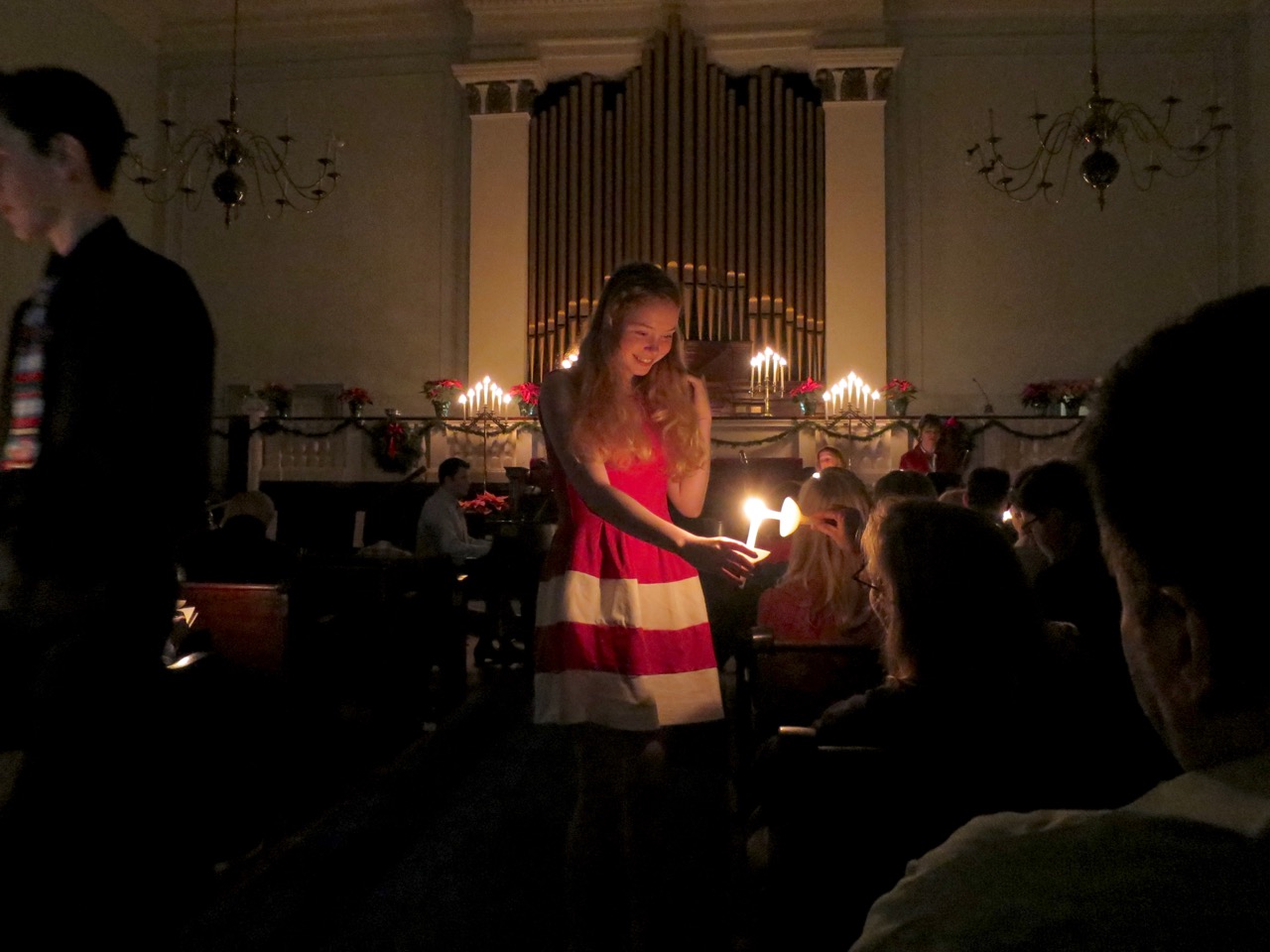
the lighting of candles in a particular order in December,

or the annual observance of  fasting on specified holidays.

All of these could be understood as doors that opened into a sacred time frame.All these rituals and traditions were practices by which human beings had stepped out of their profane daily activities and were able to live, in some sense, in the timelessness of the eternal.  Suddenly I began to realize that I had never questioned my “Swiss watchmaker’s” view of time:  that ever relentless march forward in a single line.  As the old Unitarian hymn goes, “forward through the ages, in unbroken line.” 

Worship and Timelessness

Let me give you an example very close to home.

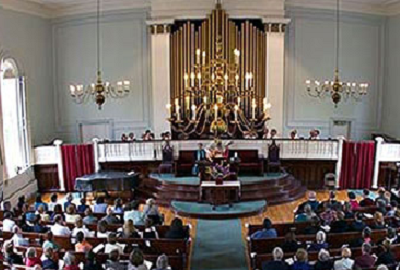
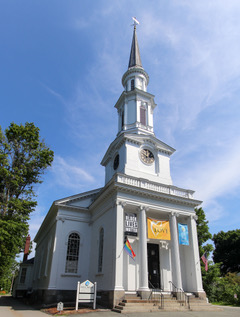
Consider the simple practice of meeting here on Sunday mornings.  Each Sunday we gather together for worship.  It could be said that when we open each service with the opening words or the chalicelighting we are entering sacred/cyclical time and when we end each service with the closing words we are returning to linear time.  What we do here on Sunday mornings for an hour or two is remarkably similar each week and significantly different from all the other hours of the week.  What is happening now is very dissimilar to what happened to each of us an hour ago or will happen an hour hence.  Yet this event is not singularly unique.  It is a great deal like the experience we had last Sunday at 10:30 AM and the Sunday before that.  Since 1691 human beings have repeated this ritual observance as this congregation here in Lexington even before the town had that name.  And since 1846 we have returned for worship again and again on Sunday mornings in this very sanctuary. 

This is no mere theatrical performance, political speech, or lecture.  You are participating in a ritual event older than this town, more ancient that our fair country; religious persons of this geographical area have returned for centuries (in nearly 16,425 services) to worship in this church. 

The Cosmic Mountain – Our Steeple

As “William Thompson” once wrote in his book The Edge of History, we are “circling back into the past at a higher and higher level”.  Linear time goes on, we can count the years, experience the losses.  Yet at the same time when we worship here on Sunday mornings we participate in a service that recollects untold generations of sacred veneration:  we are ritually close to the legions of worshippers who have ever crossed this threshold, ever sat in these pews, and all those who took time to recollect their lives and considered the meaning of their lives and God’s work in the world. 

In The Myth of the Eternal  Return, Elaide compares modern day churches with ancient myths of the cosmic mountain or the center of the world.  The church is a symbol of the cosmic center where heaven and earth meet, hence the tall steeple rising into the sky, and in our case, the beautiful woodwork nearly invisible to one standing below with unaided vision.  The symbolism is that of the navel of the world, reflecting the center from which all life began and is dispatched.  Here is the symbolic acme of our highest aspirations and our  most grounded realities.  Here we return weekly to sit within the intersection of the most holy and the most essential.  This worship service in this place exists in a point in linear history; the date and time are at the top of your order of service.  But we are also living in a sacred place in a timeless ritual. 

The Wheel of Life and Weddings

So, too, with the ceremonies of life’s passage, funerals, weddings, child dedications.  For centuries we have honored what some call the “Wheel of Life,” recollecting ourselves at life’s milestones again and again.  We find comfort in these rituals, a space to consider and celebrate life and to ponder on the deepest questions in our lives.  But we also find a sort of magic.

Consider the wedding, a ritual so ancient it is impossible to know its exact roots.  So often the words are predictable, as is the music.  But no one minds.  For a wedding, done well and in the right spirit, is outside the realm of our usual experience.  When the bride walks down the aisle, all of the particiapants and their families and friends are lifted up into a kind of magical dreamlike state.  But no one is drowsy.  Instead it’s a hyper stimulating moment, and everyone  has a sense of of sacred timelessness.

And why do so many folks want to get married in a church?  Even a church they don’t belong to?  Why not?  Why not combine the intense feelings of the wedding with the ancient archetypes of the sacred spire, the center of the universe, the nexus of heaven and earth? If you think about it, most of us have had similar feelings about events such as graduations, memorial services, and even significant career acknowledgments.  We do these events in time-honored fashion, in venerable spaces with feelings running high and our mundane day-to-day anxieties all but vanquished.  At such times we feel a part of something larger and full of meaning and significance.  At those moments we transcend our profane realities and for day or an hour or even a moment enter an eternal now.  We are in the words of Ram Dass, “Here Now” 

As you might expect, there is a dark side to this sort of “sacred time”.  Eliade points out that many destructive struggles, conflicts and wars have had “ritual cause and function”.  Many a war- monger has emphasized the “stimulating opposition between… two divinities.”  War is often cast by warriors themselves in mythical terms an episode of some divine or cosmic drama.  One only has to look at the violence of religious fanaticism to realize the powerful and irrational energies that lay in the sacred sphere,  latent and always liable for misuse. 

But for the most part, our dealing with religious time is  well worth the few fanatics we meet on the way.  Sacred time remains that which saves us and affirms us in being human. 

Tom Rush Rush

The other night I saw Tom Rush perform at my wife’s church, First Parish in Framingham.  When he began his performance I said to myself, “He looks just the same.”  I said that even though some 27 years had passed since I had last seen him.  I said that even though he actually had gained many new wrinkles and grey hairs.  But it was clear that his essence—the important part of Tom Rush—had remained in some way constant. 

And when he sang the old songs, I felt young again.  I was captivated, highly stimulated, hyper aware.  I heard with incredible clarity every note he sang, every pluck of a guitar string.  And when he did his rendition of Joni Mitchell’s “We go round and round in the circle game,” the magic was complete. It was as if I were 20 years old again—or of no age at all.  The ravages of time evaporated.  There was just what some would call the “eternal now”—only the present.   I stayed in this heightened state until I was gently set back down when the intermission began.

In a short two hours I experienced a “time out of time” and was returned to my own linear responsibilities, which included this sermon.  I was delighted.

Conclusion

In terms of time we live in two worlds, one linear and the other cyclical.  What I have discovered in my 30 years of digesting Eliade’s thought is that these two worlds are not mutually incompatible. 

Our construct of linear time is responsible for much of what we call the modern world.  In many ways it is precisely the adoption of linear time that has provided you and I with so much comfort and freedom.    But it is cyclical time that is the true liberator. Our experience of such sacred time frames allows us to transcend not just our petty annoyances but the very terror that linear time interjects into our short and precious lives.

I believe that today’s religious person has no choice but to live in both worlds.   We are most fulfilled when we accept the ambitions and advancements of secular linear view and also participate in the ancient patterns and rituals that reveal sacred time and space in all its transcendant liberation. 

And so, when you walk out the doors of this sanctuary today be mindful that crossing that threshold  is an act that has been repeated over centuries by untold numbers of worshipers.  Your coming in this morning and going out are the essential ingredients in this ancient ritual.  What happens in this hour is important and it couldn’t happen without you.  My hope is that you take something good with you, until we meet again.


Copyright© 2003 by The Rev. David C. Boyer.  All rights reserved.